Saturday, December 1, 2018

Meme Presentation

Final Version of RQ
2 Memes representative of sample & findings


Meme Presentation Outline

Final Research Question: 

How do memes concerning the Stormy Daniels / Donald Trump legal battles reinforce culturally-stereotypical attitudes on women through the combination of both image and text? 


Representative Memes:


Feedback Needed:

1. Is my explanation of Shifman and the form of communication through memes strong enough?
2. Is my research question specific enough?

Sunday, November 18, 2018

Last, and hopefully not least

Week 11: The End

The literature examined this week pertaining to the implications of the portrayal of Stormy Daniels and her legal dispute with Donald Trump through internet memes concerns academic definitions of the concept being studied, along with how previous scholars have methodologically approached previous studies on the topic.
Gender, described by Boehnke (2011) as societal expectations placed upon individuals as a result of biological sex, is examined in Drakett, Rickett, Day, and Milnes’s (2018) exploration on the implicit reinforcement of sexism through internet memes, whose methodology will be used as a guide in the study of memes concerning media events surrounding Trump and Daniels. Undertaking a feminist approach to the construction and consumption of internet memes, the study examines 240 image/text internet memes through a thematic analysis, identifying themes regarding the continued othering, denigration, and exclusion of women in an area otherwise known as part of the public sphere. Aligning with previous research on memes and gender, the proposed study will align with Drakett et al.’s (2018) selection criteria for placement within popular search engines along with the ability to view memes without registering for their respective host websites. In addition to selection criteria, similar coding strategies will take place, such as coding for individuals included, type of memes in the sample, and key words present within the text and images. Once coded, broader categories linking memes within the data set will be examined for emergence.
In application of the method of study used as a guide, all ten internet memes were found within the three major U.S. search engines Google, Yahoo, and Bing. All of the online hosts where the sampled memes were located were accessible without monetary or registration prerequisites. Once located and aggregated, the memes were coded including those pictured, type of meme humor, including one-upmanship, self-deprecation, and others, and potential perceptions created by the viewer. Relating back to the proposed research question, the approach yields themes that align to previous stereotypical understandings of gender relating to two major themes: the one-track mind and the de-emphasis of the professional woman. 
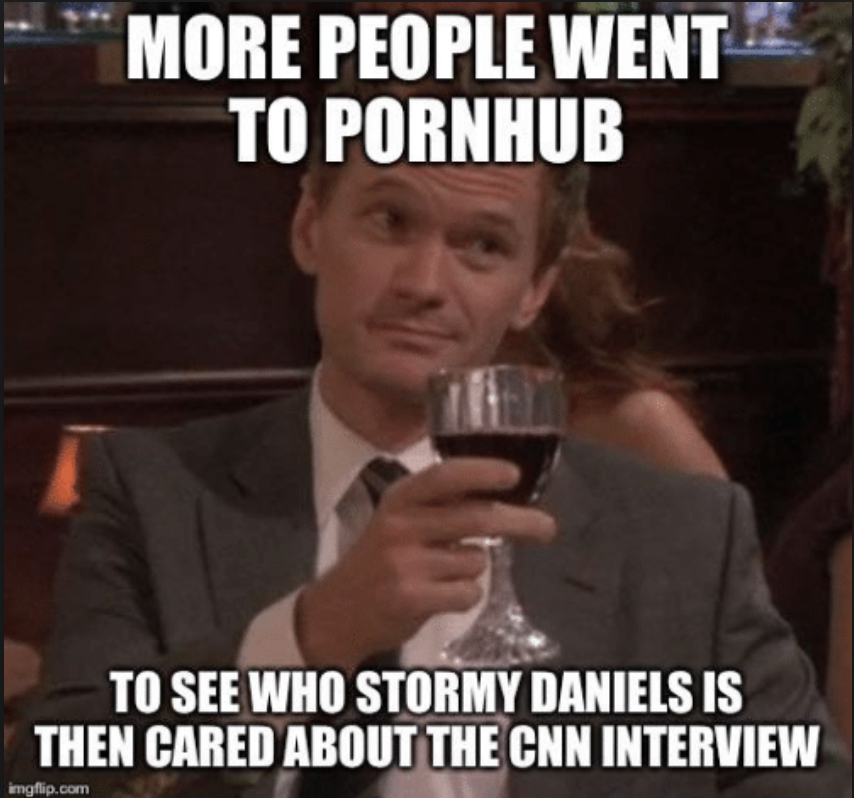
The two chosen memes, Figures 1 and 2, are representative of Drakett et al.’s (2018) method of sampling and analysis. Figure 1, an image of Daniels at a media podium surrounded by microphones belonging to various news outlets. While pictured in a media event, which is to be understood as a more professional context, the phallocentric emphasis related to a male-dominated society is evoked through the equation of microphones to penises; a fully clothed Daniels is appearing at a podium in a public context, yet the one-track mind of Daniels as sexual object is emphasized. Figure 2, utilizing the Neil Patrick Harris stock character, de-emphasizes the professional nature of the woman, focusing on a dichotomy between professional and sexual. The comparison between a pornographic video and a major news network interview invites the perception that the woman should not be attended to for her arguments or professional stature; she is more popular for her sexual nature and should not be attended to otherwise. Applying this method and these criteria are valuable as it assisted in forming the major findings that our understanding of women has not changed with a shifting societal understanding on the role of the woman. The male-centric meme creators utilizing Daniels note that more work toward increased understanding must be done.
Figure 1

Figure 2

Boehnke, M. (2011). Gender role attitudes around the globe: Egalitarian vs. traditional views.      xxxxxAsian Journal of Social Science, 39, 57-74.
Drakett, J., Rickett, B., Day. K., & Milnes, K. (2018). Old jokes, new media: Online sexism and xxxxxconstructions of gender in internet memes. Feminism & Psychology, 28(1), 109-127.

Sunday, November 11, 2018

Week 10: Case Study Arguments

Week 10, Part 2: Meme Study

Reworded RQ: How do memes concerning the Stormy Daniels / Donald Trump legal battles reinforce culturally-stereotypical attitudes on men and women through both image and text?

The research proposed will utilize aspects of Shifman’s (2014) argument on the strategic use of humor and other specific strategies within memes to promote superiority of specific individuals or cultural groups over others and either swaying or prohibiting debate from occurring within the public sphere. 
As discussed by Shifman (2014), a common quality of memetic images occurs the use of humor, and specifically the use of humorous means of one-upmanship. Content creators witness specific media events and respond to them in the creation of their own content, as they find the individuals portrayed in the initial media content to be inferior in some way. The creation of subsequent content, either in response to, or in imitation of, the initial image, video, or media event viewed, is seen as a way for the subsequent content creator to argue superiority in various ways.
Additionally, commonly humorous memes can be seen as a means of affecting political discussion in some way. While Shifman (2014) notes that these memes can contribute to a discourse surrounding a topic, the study looks to build upon Shifman’s literature surrounding the use of memes in promoting or adding to a specific discourse in arguing that memes do not exist as “common ground to discuss politics,” but to silence the opinions of differing individuals altogether (2014, p. 136).
            Figures 1 through 3 highlight the arguments being made:

Figure 1

Figure 2

Figure 3 

     The three figures shared exemplify findings themes within memes regarding the Stormy Daniels / Donald Trump legal saga and their cultural implications in regard to gender. The first major theme, as exemplified in Figures 1 and 2, promotes the notion that women in American society are unable to be seen as a separate entity from a sexualized object; as argued in advertising literature (Goffman, 1976; Knoll, Eisend, & Steinhagen, 2011), the woman is seen as sexual object through purposeful body positioning and amount of skin shown in relation to men. In Figure 1, the conscious choice to portray Clifford in a scantily-clad dress with no focus on the clothing itself next to Trump who is more fully clothed is done to reinforce the cultural idea that women are meant to be appreciated for their pleasing appearance, not the logic used in specific arguments. To argue otherwise is to argue for the culturally-illogical; thus, an opposing viewpoint is not addressed.

     Similarly, Figure 2 addresses the purposeful positioning of women. Clifford, standing at a podium filled with interview microphones, is immediately equated to her sex-worker history while in the presence of phallus-like objects. The calculated choice of using an image of Clifford mid-speech invites the perception that Clifford's history is showing to the American public; she is attempting to taint American society with her career-- an identity of which she cannot lose, partly as it reinforces the culturally-stereotypical view of woman. Lastly, Figure 3 evokes another theme found within the sample; the woman as helpless until saved by the man. It decontextualizes Clifford as an individual and paints her as the weak, feminine individual waiting for a powerful man to save the day.

     The research here is beneficial to research in highlighting that a full evolution toward gender equality in American culture has yet to take place. Despite in-person movements, such as the Women's March and the #MeToo movement, such strides toward equality are not being extended to our mediated contexts.

Goffman, E. (1976). Gender Advertisements.Cambridge, MA. Harvard University Press.
Knoll, S., M. Eisend, and J. Steinhagen. 2011. Gender roles in advertising: Measuring and            xxxxx comparing gender stereotyping on public and private TV channels in Germany. International xxxxx Journal of Advertising30(5),867-888. 
Shifman, L. (2014). Memes in digital culture. Cambridge, MA: The MIT Press.

Saturday, November 10, 2018

Week 10: Final Meme Sample

Week 10, Part 1: Memes Selected for Study


Found at:  https://me.me/i/more-people-went-to-pornhub-to-see-who-stormy-daniels-21247547


Found at:  http://www.leftcoastrebel.com/2018/03/stormy-daniels-in-50-shades-of-cnn.html


Found at:  https://russiandiaspora.org/posts/0268b5d0b3de0136bd280f91143e1ca9


Monday, November 5, 2018

Week 9: Feelin' fine

Week 9: Research Question and Application

The chosen research question for study: "How do memes concerning the Stormy Daniels / Donald Trump legal battles reinforce socially-stereotypical ideals on men and women through both image and text?" has been chosen as it clearly choses a specific media event which has taken place within a relatively small amount of time between individuals of varying gender. Each sex portrayed has had a multitude of cultural ideologies, stereotypes, and attitudes ascribed to them, whether to their benefit or misfortune.

The specific media event includes media events concerning Stephanie Clifford, also known as Stormy Daniels, including the televised interviews and other public appearances she has made during her legal battles with President Trump. Her appearances are a result of the alleged sexual encounter between the two on Trump's Golf Course in 2006. In January of 2018, Stephanie Clifford made the details of the pair's alleged encounter public, while arguing the illegitimacy of a non-disclosure agreement she was forced to sign soon after; she had argued that the agreement was invalid, as Trump had never signed the appropriate paperwork (Parks, 2018).

Stormy Daniels, the plaintiff in the lawsuits against Mr. Trump and his then-lawyer Michael Cohen, is an American adult film star, sex worker, actress, and director. Having a long career touring American strip clubs, Daniels was thrust into the national spotlight in January of 2018 when news concerning the hush money she was paid was made public. The news, coupled with the subsequent lawsuit, interviews, and arrests of high-profile individuals associated with the case earned Daniels the same amount of recognition as media-mogul Donald Trump.

The following memes will be explored in relation to the selected research question:

Figure 1

Figure 2

Figure 3

Figures 1 and 2 highlight the use of text to create drastic differences in perceptions of man and woman through subtle differences in phrasing; each of the two images are similar in visual content, yet through their use of text and the slight differences between the images of Donald Trump in the left panels and Stormy Daniels on the right, image viewers can perceive specific implications concerning the societal status of men and women. The text specifically chooses to elevate the status of Trump and other high-status men in government positions, while ascribing certain expectations to their woman counterparts. The man is meant to be professional, cannot make mistakes, and if so, the mistakes are extremely minimal and cannot be attended to. Women, on the other hand, are meant to be appreciated for their appearance and sexual prowess only. To situate women, especially Stormy Daniels, in a professional context, such as a high-profile interview, would be to neglect the cultural expectation of women.

Figure 3 highlights a similar view on sex, specifically of the sexual conquests of men, versus the promiscuity of women. While Figures 1 and 2 convey the notion that women cannot be separated from their generally-promiscuous, appearance-focused nature, the same does not apply for men. Sexual qualities that would damage the status of women, such as floozy, loose, or other women-centric insults, are typically lauded and encouraged when it comes to men, as seen in Figure 3. This double-standard has been set in American culture, historically elevating men in the home, workplace, and media while viewing the same characteristics of men as dirty and culturally frowned upon in women.

Parks, M. (2018). Stormy Daniels shares graphic details about alleged affair with Trump. Retrieved from https://www.npr.org/2018/03/25/596868354/stormy-daniels-shares-graphic-details-about-alleged-affair-with-trump

Sunday, October 28, 2018

Week 8: memes, memes, and more memes


Week 8: Even more memes


In selecting a more concrete focus for the proposed research on the cultural implications of memes surrounding the Stormy Daniels/Donald Trump legal fiasco, I am proposing five criteria of which memes must fit in order to be selected:

1.    The most basic criterion proposed for the research must be that memes must picture Stephanie Clifford and/or Donald Trump. If the individuals chosen in the memes are not the two themselves, there should be some reference to Clifford or Trump. For example, television shows such as Saturday Night Live, at many times, uses their own cast to depict certain famous figures. If memes utilize scenes depicting Clifford or Trump, they will also be accepted for study.
2.    If Clifford, Trump, or actors depicting the two are not seen in the meme, other individuals with textual references to the figures will be accepted.
3.    The second criterion selected concerns the issue of recency in content. Memes posted as early as January of 2018 will be selected for study. Trump has built a media empire around his television shows and appearances, including The Apprentice, and Clifford has earned fame through other means before 2018, so memes created before the legal issues between the two were made public will be excluded from study.
4.    In depicting the two individuals, there must be a clear, discernable dichotomy in how they are presented—either textually or visually in regard to gender. Images or text showing an elevation of the status of one gender while diminishing the social status of the other will be selected.
5.    As referred to in criterion four, a reference to gender in selected memes must be made; those specifically highlighting a difference between the male and female in American culture will be chosen.

The following examples will clarify the chosen criteria:

Figure 1

Figure 2
 Figure 3

Each of the three figures shown above highlight at least one criterion chosen for research. Figure 3 fits one of the basic requirements of visually depicting either Trump or Clifford, while the other two textually refer to Trump or Daniels in some matter, either using stock characters or other government officials. In addition, all were posted in the selected time frame of January 2018 to present day.

Thirdly, each of the memes presents a primarily textual dichotomy between men and women in American culture, either through cultural assumptions on the workplace or career, acceptance of a promiscuous lifestyle, or direct assumptions of women based on picture. To be explained further in analysis, Figure 1 highlights the notion that a promiscuous lifestyle for men is accepted, celebrated, and worthy of recognition, while a similar female lifestyle is not. Figure 2 uses text to communicate the notion that women should be attended to based on appearance and sexual usefulness, rather than any logical argument being made; if the individual in question is women, she should not be believed.

Lastly, Figure 3 uses imagery to twist the pictured context into one highlighting cultural stereotypes of the woman. While the context pictured is a polygraph test taken by Clifford in March of 2018 (Fitzpatrick & Connor, 2018), an assumption that straps around any part of a women's body is made for sexual purposes is shown through the addition of text in the sample. Clifford is seen with straps around her body, lowering the status of herself and women as a whole with what is culturally understood as a demeaning, promiscuous, sex-worker's lifestyle.

Fitzpatrick, S., & Connor, T. (2018). Lie detector test indicates Stormy Daniels truthful about Trump  ddddd affair. Retrieved from https://www.nbcnews.com/politics/politics-news/lie-detector-test-shows-ddddd stormy-daniels-truthful-about-trump-affair-n85828.


Monday, October 22, 2018

Week 7- Refining Topic

Week 7- Refining Project Topic

My proposed research study explores the theme of gender related to Stephanie Clifford and media coverage related to her interviews and political-related demonstrations as a result of her legal battles with President Trump and his then-lawyer Michael Cohen in early 2018; the interviews and demonstrations examined concern a non-disclosure agreement between Trump and Clifford over an alleged sexual encounter at a Trump resort in 2006.

My proposed research question for this study is the following: How do memes centered around the Stormy Daniels / Donald Trump legal battles reinforce socially-stereotypical ideals on men and women through both image and text?

As Clifford’s media coverage in 2018 predominately concerns these legal battles, I will study 10 internet memes related to Trump and Clifford, either related to Clifford’s March 9 CNN interview, or other images of the two posted within the last 10 months.

Memes will be selected on the following criteria: they must be posted after January 1, 2018, depict Stephanie Clifford, Donald Trump, or both, or either refer to one or both of the pair through the use of text within the meme. Lastly, memes will be selected if they refer to the social placement of men and women in American society, whether the workplace, the home, or culture in general.

The following two memes will assist in exploring the proposed topic:

The first meme selected concerns Clifford's March 9th CNN interview, where it appears as if her pupils are dilated. Memes surrounding this aspect of Clifford's appearance can be argued to show a link between Clifford and the cultural perceptions surrounding her work. We generally understand sex workers to be almost nonhuman; those who have these jobs are generally understood to be dirty, drug-addicted individuals. With the appearance of dilated pupils, the meme's creator posits the idea that sex-worker Clifford and professional Clifford being interviewed by a major news corporation are inseparable. Ignoring all other contextual clues, such as possible lighting changes attributing to her appearance, the meme highlights certain ways that Daniels, as woman sex-worker, is a nonperson who should be ignored.


The second meme, captured from me.me, uses an older photo of Clifford with text showing a connection to the legal drama. Its use of text highlights a notion of the helplessness of Clifford, and women in general, in obtaining employment without the assistance of a man, to be explored in further detail.

The two memes chosen highlight some of the varied cultural stereotypes on the dichotomy of man versus woman--the woman as promiscuous in all aspects of life and the woman as helpless, hopeless individual.